
Many organisations manage portfolios of brands that look differentiated on paper, yet behave identically in market. This is often because each brand is given the same broad mandate to ‘grow awareness’ within the same category, creating internal competition for attention and resulting in media plans that converge on the same moments, channels and messages.
In practice, this reflects the absence of a clear (or optimal) way to organise where each brand should focus and how it should be deployed.
We believe that Category Entry Points (CEPs) offer a powerful route to assigning distinct roles to each brand, by anchoring them to different situations, needs or occasions that drive engagement with category brands. They force clarity about when and why a brand should come to mind, more so than its intended positioning or personality.
It’s not about confining a brand exclusively to these CEPs, but rather maximising impact by resisting the urge to spread effort thinly across every possible occasion.
Assigning Unique Roles Across A Portfolio
Much great CEP work has focused on growing mental availability for individual brands (read more about how CEPs sharpen brand strategy here). However, a more compelling application for multi-brand organisations can be deciding which brands should target – and look to dominate – which entry points.
In practice, this becomes highly structured. A key output of our CEP work is a dendrogram, which maps how entry points cluster and branch across the category. This reveals the underlying structure of demand – how the category is organised in consumers’ minds.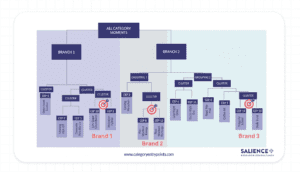
Importantly, this structure is not purely descriptive. It also provides an additional lens for prioritisation: CEPs that sit close together on the dendrogram may create opportunities for shared efficiency in media, creative, or activation, while more distant CEPs may require distinct strategies.
We combine this lens with additional factors such as CEP size, brand favourability and growth headroom to create a bespoke prioritisation framework, helping organisations determine where each brand should focus improving its mental availability.
Working through this process with clients forces explicit trade-offs across the portfolio. It creates clarity about where each brand should concentrate its investment, resolves tensions between brands competing for the same spaces, and ensures roles are assigned deliberately rather than by default.
Crucially, this is less about finding the ‘right answer’ and more about making strategic trade-offs visible and deliberate, ensuring the portfolio collectively covers a fuller range of CEPs. While it’s not always a problem for multiple brands to show up within the same CEP, overlap is now intentional rather than accidental.
CEPs In Action Across Portfolios
Across categories, portfolios are consistently structured around distinct entry points rather than purely product differences.
Take P&G’s laundry portfolio. Tide and Gain are, in functional terms, similar products competing in the same category, yet they are associated with very different situations. Tide’s long-running platform – ‘if it’s got to be clean, it’s got to be Tide’ – aligns it with high-stakes stain removal moments, whereas Gain is linked to everyday laundry occasions where scent and freshness are the priority.
The distinction lies not in the product, but in when each brand comes to mind.

A similar pattern can be seen in infant nutrition portfolios such as Danone’s Aptamil and Cow & Gate. While both operate within the same core category, they are often associated with different parental decision moments. Aptamil tends to align with more considered, science-led feeding decisions, whereas Cow & Gate is more closely linked to everyday, accessible feeding occasions.
This allows the portfolio to serve distinct needs without brands competing for the same mental space. And indeed where the brands do compete for the same CEP, the Danone will have two brands of different positioning to leverage, depending on the specific consumer and their functional or emotional needs.

The same logic applies in a branded-house structure. For example, different Nescafé sub-brands map onto distinct consumption occasions: quick, solo weekday coffee moments (Nescafé Original), elevated everyday coffee consumption (Nescafé Gold), and premium, café-style experiences at home (Nescafé Dolce Gusto).
Here, the masterbrand stretches across a broader range of situations, while individual sub-brands anchor specific moments within the broader portfolio.

Applying CEP Thinking To Activation
Once roles are clearly defined at a portfolio level, the real impact of CEP thinking is felt in how brands are planned, activated and grown. In practice, this plays out across:
- Creative direction – which moments are we relating to, and what cues should trigger the brand?
- Media planning – when and where should we show up to reach people in these moments?
- Product development – how can our offering reinforce relevance in these situations?
In multi-brand portfolios, the cost of unclear roles is often felt most acutely in execution. When brands lack distinct entry point priorities, they don’t just look similar in market, they actively compete with one another for the same moments, media environments, and attention – fragmenting investment and diluting impact.
This is often framed internally as a problem of overlapping audiences, when really the issue is overlapping occasions. Multiple brands end up showing up in the same situations, with similar messages, delivered through the same channels.
CEP-led portfolio planning can provide a practical way out of this. By allocating emphasis around different entry points, brands naturally diverge in where and when they appear.
Media plans become more complementary, creative differences become meaningful rather than cosmetic, and investment works harder at a portfolio level rather than being spread thin across competing brands. Product innovations are tethered to the brand that makes the most strategic sense.
This is clearly illustrated in how Nike manages its core brand and the Jordan brand. Breakthrough performance technologies are launched under Nike, reinforcing high-stakes performance entry points like elite competition and marginal gains.
By contrast, basketball culture, lifestyle-led drops, and retro silhouettes tend to sit under Jordan, aligned with entry points around self-expression, cultural credibility, and off-court identity.
Organising Brands By Situations, Not People
Consumer segmentations continue to play an important role in brand planning, particularly when it comes to tailoring executions.
However, when it comes to deciding how multiple brands should most effectively co-exist within the same category, we maintain that situations matter more than people. Segment-led thinking tends to encourage brands to narrow their focus to specific audience types, while at times also over-emphasising who they fundamentally don’t want to target.
The challenge is that the same individuals enter a category for very different reasons at different times, and may find different brands relevant depending on the situation they are in.
Consider streaming entertainment. The same person might watch family-friendly content on Disney+ in the afternoon, binge adult shows on Netflix in the evening with their partner, and turn to YouTube for short-form, solo on-the-go content. From a portfolio perspective, these are not different ‘types of users’, but different entry points into the category.
CEPs, we argue, provide a more fundamental foundation for portfolio strategy. By organising brands around situations and moments rather than audience types, organisations can allocate distinct roles across brands without artificially limiting reach, while still using segmentation downstream to optimise how each brand shows up once its role is clear.
Balancing Focus Today With Growth Tomorrow
Ultimately, we believe effective portfolio management is about focus, clarity, and thoughtful allocation. By identifying and prioritising the right category entry points for each brand, organisations can assign distinct roles, reduce internal overlap, and ensure the portfolio collectively covers the full spectrum of category demand. Growth doesn’t come from every brand shouting louder – it comes from each being present in the moments that matter and where it can win.
Of course, this does not mean brands should be confined to a narrow set of situations forever. Over the long term, growth depends on building broader networks of CEP associations – reflected in key Mental Availability metrics such as Network Size (the average number of entry points a brand is linked to).
In practice, however, most brands need a clearly defined set of priority CEPs initially to maintain focus, avoid internal competition, and establish a strong mental role within the category. Once they have effectively penetrated these, brands are far better positioned to expand into adjacent entry points in a deliberate, coordinated way.
With clear CEP priorities guiding each brand, mental availability can be built in the moments that matter most – and extended over time – allowing the portfolio to operate as a single, co-ordinated engine of growth.
To explore how using Category Entry Points can be applied within your portfolio, check out our resources & blog here, or get in touch to dive deeper into the topic.