Category Entry Points Examples: How Brands Drive Growth

Category Entry Points are proving to be one of the most useful frameworks in helping marketers create more strategic marketing plans. The thinking, developed by Byron Sharp and Jenni Romaniuk of the Ehrenberg Bass Institute, can unlock a more focused brand strategy. Below are some Category Entry Point examples in action to show how their use can drive your strategy and tactics. Their use has so many applications, spanning advertising messaging, strategic initiatives, physical availability, measurement, and product innovation, among other areas.

Aperol

Aperol Spritz is one of the best Category Entry Point examples in the alcohol category, focusing heavily on the apéritif moment. The apéritif is a pre-dinner drink traditionally very popular in southern Europe to stimulate an appetite, but now very much a ritual for many a consumer across most demographics globally. The focus on this CEP helped Aperol create a foothold across cafes & restaurants globally, creating a popular ask for consumers while also heavily featuring on menus. Aperol, to this day, still focuses on this CEP across their communications, in doing so knowing its importance, but as the brand has scaled in more mature markets, it has also become salient for at-home consumption CEPs, especially in times of good weather. In addition, the serve has become a key Distinctive Brand Asset for Aperol, helping create a distinctive brand.

Many brands can learn from this approach, having one or a few hero CEPs that remain consistent and drive volume, which can be the focus in early-stage markets. However, the breadth of CEPs should grow over time in order to scale, hence brands like Aperol also put lots of energy into the off-trade to target at-home gatherings or other new related CEPs. This is a further example of where mental and physical availability overlap. The brand, through its communications, needs to drive salience for "drinking at home" CEPs, but they also need to be prominent from a physical availability perspective, ensuring good listings and shopper marketing specials.

Category Entry Point Example Aperol-Spritz-Aperitif
Snickers-Category-Entry-Point-Case-Study

Snickers

Snickers is a great example of how to use CEPs to cut through in a very competitive category such as chocolate & confectionary. A rudimentary strategy for Snickers would be to solely focus on driving awareness of Snickers as a chocolate bar, measured using metrics such as prompted or top-of-mind awareness only. This is still quite a common approach for many FMCG/CPG brands, having a blunt strategy with little focus or prioritisation. Snickers took a different approach to cut through which can be seen via their "You're not you when you're hungry" campaigns. We hypothesise that their strategy here would be along the lines of "Become the snack of choice for hungry people the world over", with a focus on being salient for the CEP(s) around those moments of hunger outside of meals. They then executed this excellently in advertising, with campaign messaging associating the brand with these CEPs. Snickers also benefited from their focus CEP(s) having a universal appeal, therefore it could be rolled out globally, albeit with nuances by market. The measurement of these CEP(s) also helps show how our definitions of categories as marketers does not reflect real life and is quite limiting. A common measure, with the blunt strategy mentioned above, would likely be "What chocolate bars do you consider/think of?". In their more focused strategy around snacking outside of meals, Snickers are competing with several categories, food types and brands. Some people would satisfy their hunger with a bag of popcorn, others crisps/chips, and others perhaps with some healthy nuts. By measuring against snacking & hunger-related CEPs, Snickers has a better picture of brand health and indeed their direct and indirect competitors.

Walkers

Walkers Crisps is the UK’s largest savoury snack brand (crisps/chips) with around 25% of the market. Walkers Crisps is such a big brand because it is so salient across so many entry points. As a big brand, they are smartly & consistently looking for new opportunities to grow sales further. They identified that crisps make a “lunchtime sandwich more exciting” but less than one in ten eat crisps at lunch. The brand tried to change people’s lunchtime behaviour, by associating the snacking of crisps with sandwiches or other lunchtime meals as a way of opening up more of the market. As well as driving this via communications, one can see how this plays out via physical availability with a focus on driving additional distribution via sandwich or cafe chains to create a truly omnichannel campaign.

Example of Category Entry Point Walkers Snacking
Category Entry Point Case Study Alcohol

Jameson

Jameson, like all large brands, is big because they are salient across so many Category Entry Points or occasions. It is a nice sipping whisk(e)y while watching the football, it is often the brand of choice in Irish coffee, it makes a great pantry filler whisk(e)y, and it can make a delightful gift at Christmas. A number of years ago, Jameson identified a key Category Entry Point to focus on. Their core target market was/is L.A.D.S (It's an acronym, but think of your typical 18-35YO male pub frequenter). They identified an important CEP for this group, where after 3 or 4 pints, they were often "full", and wanted something lighter and a drink that could provide a kickstart to the night as it moved from casual to higher tempo. For this, they created the "Jameson, Ginger & Lime", a serve which was a key feature of their trade and experiential activity in several markets. This refreshing and accessible drink was also a key feature of their advertising, with the objective of being salient for this CEP and that specific moment in the night.

The use of the Jameson, Ginger & Lime was also broadened over time to help drive volume in the off-trade with messaging and special packs to help communicate how easy it is to make at home.

Red Bull

Red Bull is a standout example of how Category Entry Points (CEPs) can be engineered and owned through radical strategic focus. From the outset, it has positioned itself not around taste or refreshment, but as the solution to specific moments of depletion and ambition – “Red Bull Gives You Wings”.

Rather than competing within traditional beverage cues, Red Bull inserted itself into situations where a mental or physical lift was essential, and whereby the competition might include both other drink categories (e.g. coffee) or simply going to sleep. This includes targeting high-pressure, high-need occasions: students pulling all-nighters, gamers in long sessions, or people seeking a boost during late-night work. Tactics such as handing out cans at clubs or during exam periods directly reinforced these energy-urgent moments.

As Red Bull grew, it expanded this strategy into a global ecosystem of media, sports, and cultural properties which embody its CEPs. Ownership of extreme sports events, creative platforms, and even professional teams delivers both physical and mental availability for the brand.

Red Bull demonstrates that brands win not by appealing everywhere, but by becoming indispensable somewhere. By shaping and reinforcing occasion-based entry points, Red Bull turned a niche functional promise into global category leadership.

Airbnb

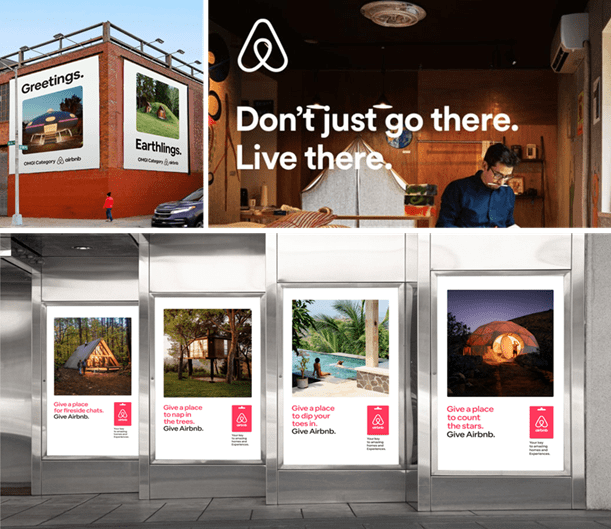
Airbnb provides a masterclass in leveraging Category Entry Points (CEPs) to disrupt an industry and reposition traditional battlegrounds.

During its initial rise, Airbnb focused on the functional CEPs of affordable accommodation and a simple hotel alternative, successfully capturing share from budget-conscious travellers. To unlock further growth, Airbnb then identified and successfully tapped into additional CEPs which traditional hotels weren’t serving well – most notably a desire for authentic, local, and unique experiences. This repositioned accommodation as a key cultural component of a trip, rather than simply a place to sleep.

Their marketing continually reinforces this desire to “live like a local” – shifting the competition from “who is cheaper?” to “who offers the most authentic way to travel?” Crucially, product features such as Experiences and Categories were introduced to anchor these new CEPs, cementing Airbnb’s dominance in this differentiated territory.

Alongside its increased focus on experiential CEPs – and, ironically given its roots, some pushback around price – Airbnb has more recently targeted the key CEP of group bookings. Its “an Airbnb” campaign challenges hotels on both value and comfort.

Airbnb demonstrates the importance of sequential CEP targeting for growth. By prioritising specific moments and needs over time, the brand achieves clarity in marketing message and measurement, rather than attempting to target all occasions and audiences at once.

Corona

Corona offers a compelling example of a brand first achieving dominance in a single, powerful situational trigger, before strategically expanding its reach.

For decades, while competitors focused on Category Entry Points like game days or national holidays, Corona’s global creative platform built powerful mental availability around the CEP of “when you are on a tropical beach or holiday.” Nowhere is this commitment more evident than Corona’s “O Tannenpalm” Christmas advert, which shows a single cabana beside the ocean and has been used for over three decades. Historically, the brand has seen strong comparative sales uplifts versus competitors during this period.

Critically, Corona has used this narrow but defensible association as a Trojan horse to expand into broader, higher-frequency purchase moments, while maintaining a distinct positioning. The core CEP evolved from a literal place into an aspirational mindset, translating the beach image into universal emotional CEPs such as relaxation, disconnection, and celebration.

Campaigns like “Find Your Beach” demonstrate this pivot, showing consumption in non-beach settings where the product ritual (opening the bottle, adding the lime) mentally transports the consumer to that state of mind, reinforced by ocean sounds. This expansion into additional CEPs has also enabled seamless brand extensions targeting non-beer drinkers active in these moments, such as Corona Hard Seltzer.

The Collective

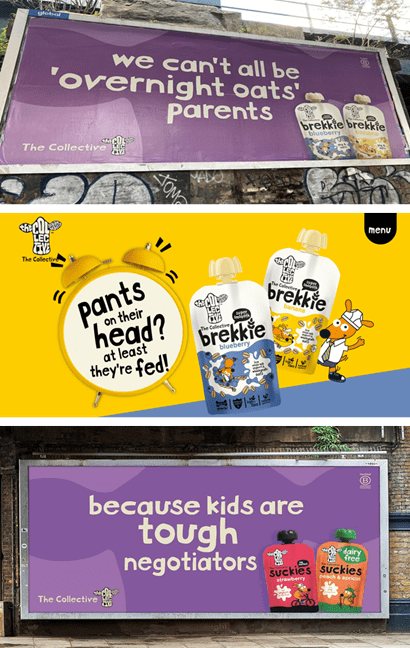
The Collective is a New Zealand-born dairy brand which has recently penetrated the UK kids’ breakfast and snacking categories, providing an interesting case study of a challenger brand leveraging highly emotive Category Entry Points (CEPs) to cut through.

Rather than competing with dairy giants on price or health claims, The Collective maximises its smaller marketing budget by focusing on winning the battle against parental stress and guilt, in moments where the zero-prep, zero-mess convenience of its products is most valuable.

Its Brekkie pouch plays to the CEP of wanting to feed children a healthy yet convenient breakfast amid the chaos of the morning routine, while its Suckies pouch taps into the “snacking negotiation” CEP. Both products lean into relatable chaos, rather than the aspirational perfection often portrayed by larger competitors.

This demonstrates a key CEP principle: a brand’s competition is often broader than it initially appears, and brands must be choiceful about where they want to win, based on their maturity and spending power. The Collective recognises it is not just competing with other yoghurt brands, but with a wide array of children’s breakfast and snacking options.

Rather than focusing solely on functional benefits (although these are clearly communicated on-pack), the brand links them to a powerful emotive CEP territory — guilt-free relief — allowing it to tap into specific, high-frequency parental anxieties and build meaningful mental availability.

Haagan Dazs

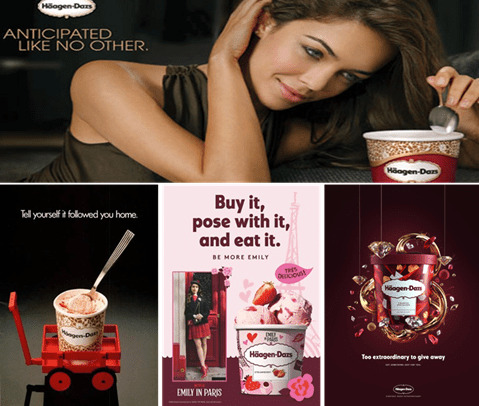
Häagen-Dazs exemplifies total alignment between brand positioning and priority Category Entry Points (CEPs). It deliberately eschews lower-margin, mass-market ice cream occasions—such as kids’ snacks or casual social gatherings—and instead focuses on premium CEPs: personal indulgence, romantic moments, sophisticated adult desserts, and special occasions. Its European-sounding name and premium price point reinforce this positioning.

The brand strengthens these moments through disciplined marketing. Advertising emphasizes intimate, slow, and often solitary enjoyment, typically featuring adults or couples, and is placed in prime-time or late-night programming where consumers are already in an indulgent mindset. In-store executions and occasion-specific products, such as Valentine’s Day specials, further reinforce these priority CEPs.

Häagen-Dazs’ success demonstrates the value of being selective about which moments to own. By focusing on high-value occasions, the brand builds strong mental availability and category share, while still benefiting from spillover sales in broader frozen treat occasions.

Dominos

Domino’s has grown into a category giant not by emphasising product superiority, but by building exceptional mental availability across key Category Entry Points.

While many competitors continue to market on taste, think Papa John’s long-running “Better Ingredients. Better Pizza.” slogan, Domino’s has focused relentlessly on owning the CEP of delivery convenience. Even though its famous “30 minutes or less” guarantee is no longer universal, tech innovations like the Pizza Tracker and AnyWare ordering reinforce the same core trigger: “We need dinner now, and I don’t want to cook”, for which Domino’s is the answer.

Marketing centred on group consumption has built strong associations with family feasts and big nights in, while targeted media and sponsorships reinforce CEPs such as late-night cravings and post-night-out recovery.

By systematically attaching itself to these common decision moments, Domino’s has become the most mentally available brand across multiple delivery occasions - driving both frequency and share within the online food delivery sector.

Baileys

Bailey's is another example of a brand that is interesting to look at through the lens of Category Entry Points. A significant portion of their early growth in certain markets came from their association as a drink to serve over ice at Christmas time. This was, and still is, an important CEP for the brand. Over time, however, this narrow focus was restricting growth potential, and the number of occasions the brand could play in. To counteract this, the brand reframed the brand from a "one-off festive blockbuster to millions of triggers to treat", via the "Don't mind if I Bailey's" campaign.

This campaign communicated to consumers that Bailey's was the perfect drink for brunch, at home on the sofa, or a sweet finish after a meal. This was expanded even further to show how Baileys could also be a key ingredient in deserts. The broadening of CEPs helped the brand return to growth.

Read more about this very informative case study via the IPA.

Image source: Mother London via Creative Brief

Duolingo

Duolingo capitalises on the frustrations faced by UK commuters with targeted creative advertising encouraging them to spend idle time learning a new language via their app, and is a good Category Entry Point example in the digital space.

Limited mobile coverage such as that on the London underground, plus bus, train and traffic delays often leaves commuters with wasted time. Duolingo has identified this as a Category Entry Point for their free learning tool, which includes available offline content. This is a good example of how CEP research can aid innovation; informing new SKUs or features. 

The clever advertising campaign launched in 2019 also sees Duolingo tie in their ‘Duo’ owl character, their critical Distinctive Brand Asset, merging two of the most influential and measurable marketing concepts.

Floradix

Floradix liquid iron is a popular dietary aid used for treating iron deficiency and anaemia, with 1 in 4 people suffering from such deficiencies globally, however much less are aware of it. Playing only within this space, Floradix would be restricting its relevant target audience and “occasions”.

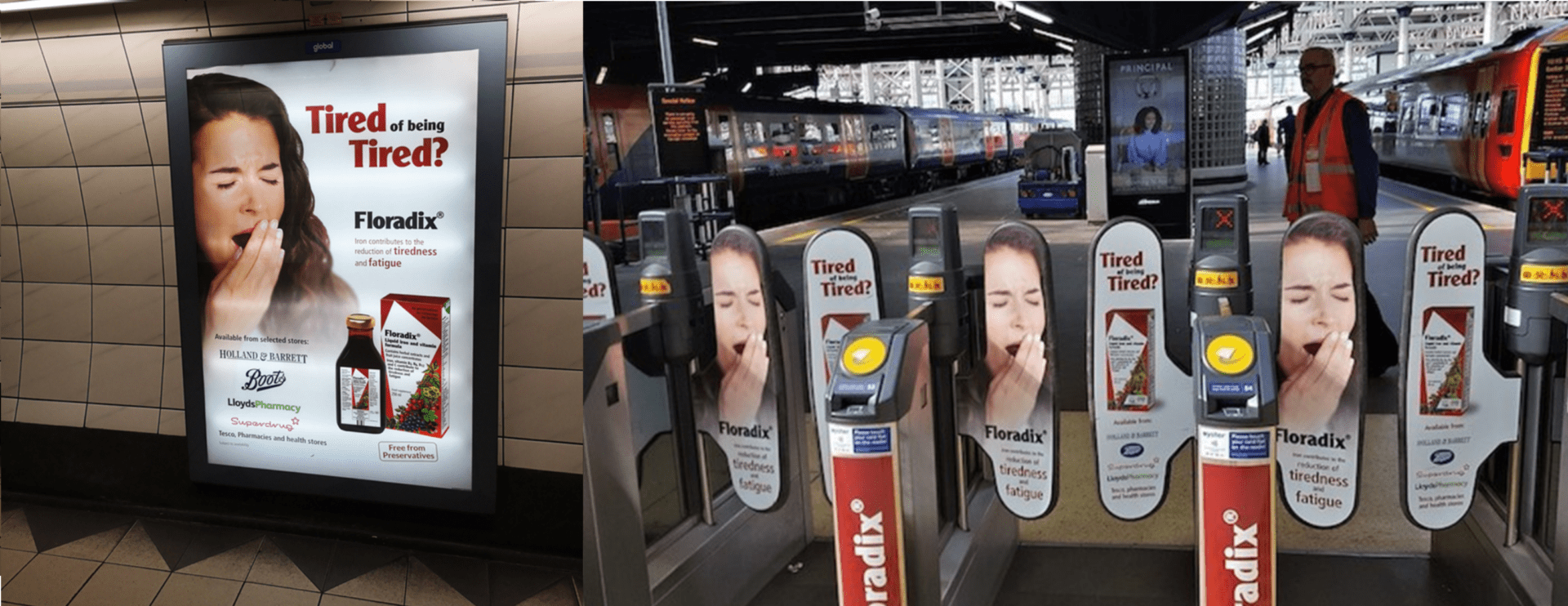
Iron, plays a key role in oxygenating the blood and a deficiency can cause people to feel tired and fatigued. This angle offers Floradix a much broader audience of people capable of self-diagnosing their need for a solution. The ‘health supplements’ category is, however, a crowded market to own, maintain and grow brand salience so how to do this efficiently? …enter Category Entry Points.

By recognising that the commute to work (before a busy day) and coming home from work (wishing they had more energy after a hard day) were key category entry points for a solution to tiredness, Floradix embarked on an OOH campaign covering the London underground and overground rail networks.

This campaign drives traditional ‘top of mind awareness’ for the brand but, moreover, it does so at a point when the consumer is in the mental space to engage with the category. According to the design agency behind the ad (Prism), this positioning, messaging and execution against a key CEP has helped sales of Floradix increase by 20%+ since the campaign’s launch over 10 years ago.

Learn More About CEP Research

Contact us to unlock the moments that matter.

Identify priority category entry points
Build a profile of key CEPS
Measure mental availability in context

    Resources & Blog

    How CEPs unlock smarter portfolio strategy

    | Uncategorized | No Comments
    Many organisations manage portfolios of brands that look differentiated on paper, yet behave identically in market. This is often because…

    Guinness: A Masterclass in Utilising Category Entry Points

    | Uncategorized | No Comments
    Guinness is over 260 years old, but the Irish stout brand remains a beacon of modern brand-building. The brand is…

    Planning With Context: How Category Entry Points Sharpen Brand Strategy

    | Uncategorized | No Comments
    One of the primary reasons I gravitated towards Category Entry Points when they were first introduced by Jenni Romaniuk and…

    Read more