
Category Entry Points (or CEPs) are the reasons, motivations, and occasions that prompt consumers to consider a specific product category. They represent the triggers or situations that lead customers to recognise a need and explore options within that category.
Unlock the moments that matter with
Category Entry
Point Research
 Identify priority Category Entry Points
 Build a profile of key CEPs
 Measure mental availability in context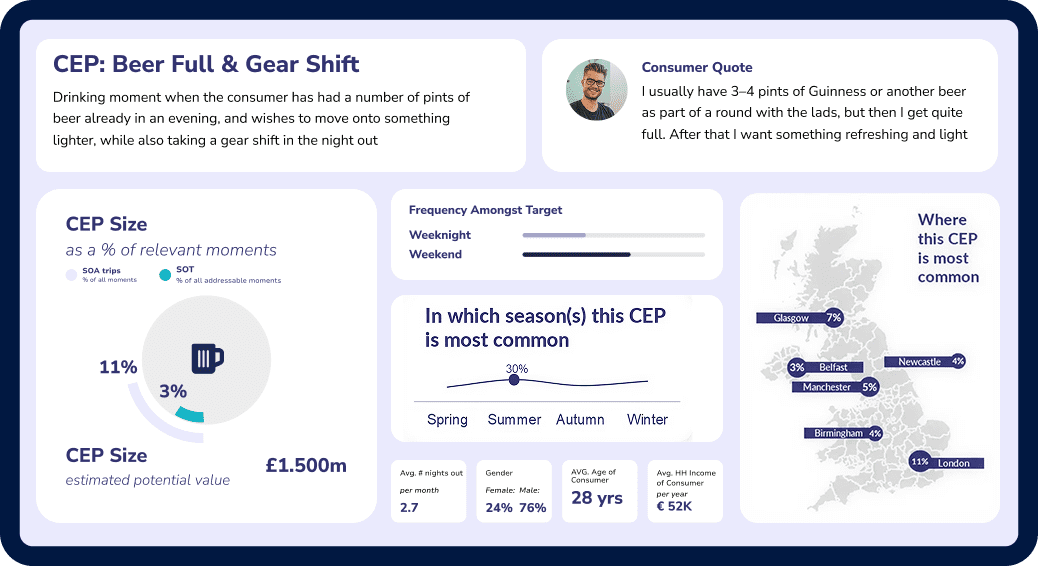

Trusted by market-leading brands








What are
Category Entry Points

THE MOTIVATION
Why are you buying a product?
“I want an energy boost”

THE TIMING
When are you buying a product?
“Before the gym”

THE FEELING
How are you feeling?
“I’m feeling lethargic”

THE LOCATION
Where are you buying a product?
“Corner shop, near the Gym”

THE CONTEXT
With whom / what are you with?
“With my gym buddy” or “I need an energy powder to add to my water”

THE CONTEXT
While doing something
“On the way to the gym”
Why are they
Important?
Category Entry Points, originally developed by the Ehrenberg-Bass Institute, are the cornerstones of Mental Availability (i.e. brand salience).
Improving Mental Availability makes your brand come to mind more easily at key purchase decisions and occasions, and is critical for brand growth.

Mental Availability
EASY TO THINK OF

Physical Availability
EASY TO BUY
Category Entry Point
Research & Measurement
At SaliencePlus we have a two-stage process, firstly to identify Category Entry Points and secondly to measure and track mental availability within those CEPs over time.

Stage 1:
IDENTIFY
Exploratory Research
In the “Identify” stage of our Category Entry Point research, we model each CEP using various relevant data points through quantitative research. This approach reduces subjective biases from methods like internal development or workshopping.
The consumer data is processed through our proprietary modelling engine, an advanced statistical solution, to pinpoint the most influential W’s, and other factors, for driving purchases in your category. Our expert industry team then reviews and refines these Category Entry Points, enhancing them by profiling the demographics, attitudes, and behaviors linked to each.

Stage 2:
MEASURE
Validatory Research
Our Category Entry Point measurement system operates like an advanced brand health tracking study, focusing on spontaneous brand consideration and awareness (plus prompted) within each CEP and other key metrics.
At regular intervals, we ask a fresh audience of real-world consumers which CEPs they engage in and, for each, which brand(s) they currently consider buying from. We trend brand mental availability within each CEP over time, allowing us to track performance against marketing activity.
Our approach to mental availability measurement ensures you capture the key metrics traditional brand health tracking fails to do, helping modernise your brand tracking, and measure what really matters.
Client Testimonials

”SaliencePlus has quickly become our #1 strategic partner when it comes to all things Category Entry Points. The methodology gives depth and flexibility at speed, with the true value and impact coming from the team’s collaboration and expertise. It also helps that the output always looks smart and punchy so lands well with stakeholders and elevates the business implications.
Katie KaylorGlobal CMI Director, MARS Foods
”The work we did with SaliencePlus to identify the Category Entry Points for online casino was truly eye-opening, and allowed us to develop an effective portfolio strategy in which each brand had a distinct and globally unified marketing strategy.
Wes GodwinBrand Marketing Director, Betway
”It was a pleasure working with SaliencePlus.
Abhiroop MukhopadhayaHead of Consumer & Market Insights (CMI), Unilever
Their approach clearly pulls apart moments when consumers become category engaged, leading to identification of top consumption themes for the category. I am sure this piece will enable our brands to drive competitive advantage in the future.
Category Entry Points
A deeper understanding of Category Entry Points can offer actionable insights to enhance your brand strategy and marketing efforts. These insights enable a more targeted strategy and provide a more comprehensive method for measuring brand performance. They can help guide areas such as:

BRAND MEASUREMENT
Assess your brand's performance across CEPs, as well as your competitors

BRAND PLANNING
Helps inform brand planning and the path to purchase

STRATEGY & PRIORITISATION
Understand which CEPs matter for growth, where do you need to build mental availability?

AUDIENCES
Understand performance across segments, are any demographics holding you back?
BARRIERS TO GROWTH
Understand where you have mental availability issues which are limiting growth
COMPETITOR INSIGHT
Gain a better understanding of where and how competitors are growing
MARKETING OR COMMUNICATIONS EVALUATION
CEP(s) can be used as a KPI(s) for marketing activity or communication campaigns
COMMUNICATION MESSAGING
Helps inform messaging, what should you be saying in order to build mental availability against key CEPs?
GAP ANALYSIS
Understand gaps across the company portfolio or product features. Helps inform innovation pipeline
Evolve your
Strategy & Brand Health Tracking
Most Brand Health Tracking is based on the traditional funnel and lacks purchase context. We use Category Entry Points (CEPs) to introduce context to purchase decisions. Category Entry Points are reasons, triggers or occasions when someone considers buying a product in your category. By knowing your priority CEPs, attaching your brand to them, and measuring performance, you can improve Mental Availability.
 Measurement Focus
 Category Definition
 Customization
 Activity Measurement
 Internal Adoption
Old Tracking
Modern Tracking
Case Study
Spotify
Modern marketing science has highlighted the immense importance of mental availability in triggering consumer purchase. Simply put, being top of mind at the point at which a consumer intends to engage in the category, and subsequently being available to them at this time, wins.
To provide a more focused brand strategy that targets the key areas to win, Spotify commissioned SaliencePlus to conduct CEP research in several key markets, as well as measure performance against these CEPs.
Key Questions Answered
- What are the priority CEPs, and how does this vary by market?
- What is Spotify’s right to win in these CEPs, and where is the low hanging fruit?
- Which CEPs should form part of the brand plan and become the foundations for more robust marketing activity measurement?
- How does Spotify perform against all CEPs, especially the priority CEPs?

Case Study
Horlicks (Unilever)
In a competitive category, driving additional growth requires a nuanced assessment of where to focus and how well the strategy is performing.
CEP research offered this nuanced lens by identifying which purchase moments are best suited to the brand, and which should be prioritised. The end goal is to leverage the extensive Horlicks portfolio to address a wide spectrum of CEPs and build TOM across the relevant ones.
Key Questions Answered
- What are the key CEPs across segments and regions?
- What are the priority CEPS based on a custom appeal index?
- Are there any future innovations that could address priority or new CEPS?

Case Study
Canva
Canva is a global online visual communication and design platform, empowering individuals, teams, and businesses to create everything from presentations and social media content to marketing materials and documents.
To better understand potential areas of growth, they tasked us with identifying the Category Entry Points relevant to Canva by mapping the spectrum of moments when people use online creative tools.
Key Questions Answered
- Identify and prioritise the Category Entry Points that provide growth opportunities.
- Determine which communication messages will help build relevant salience.
- Track performance within priority CEPs over time.

Case Study
Bens (Mars Foods)
Winning the moments that matter in FMCG/CPG is key, and modern organisations recognise the importance of being top of mind during these moments as critical for driving growth. Our work aimed to understand which CEPs were key to the brand and then track performance against them over time.
Key Questions Answered
- Which CEPs are the priorities, and how does this differ by market?
- Where are the untapped opportunities for growth?
- Which CEPs should receive greater focus within strategy and activation plans?
- Which CEPs should sit at the core of the measurement and evaluation framework, and be consistently tracked across markets?

Case Study
Wells Enterprises
Wells Enterprises are one of the largest ice cream manufacturers in the U.S., with a number of iconic brands.
They tasked SaliencePlus with identifying the Category Entry Points relevant to Wells, across the portfolio, in the U.S., by mapping the spectrum of moments when people consider and buy Frozen Treats.
Key Questions Answered
- Which are the most common CEPs in the market, and how do they differ?
- Based on a custom prioritisation, which CEPs offer the greatest growth potential across brands?
- How do all portfolio brands perform and trend over time across their targeted CEPs?

Case Study
Betway
Betway are a leading global sports and casino brand. They undertook CEP research to help develop a global strategy that had alignment across markets, but also allowed for local flexing.
Key Questions Answered
- What are the key CEPs across markets?
- What are common CEPs across markets and what are local specific?
- What CEPs could the global Betway team support with in terms of marketing assets, and what should local teams own?
- How does Betway perform across all CEPs with their key brand and sub brands?

Learn More About CEP Research
Contact us to unlock the moments that matter.
 IDENTIFY PRIORITY CATEGORY ENTRY POINTSBUILD A PROFILE OF KEY CEPSMEASURE MENTAL AVAILABILITY IN CONTEXT
Frequently Asked Questions
Everything you need to know about us
What are the differences between Category Entry Point research and other research related to motivations, need states, or occasions?
While there are some similarities and overlap, our approach to CEP research aims to be agnostic to the variables of importance to buyers, and so is less biased from the get-go. While motivations and need states help to explain why people feel or want something, and demand spaces/occasions cluster people into experiential or usage contexts, CEPs are about the specific situational, social, and contextual prompts that make a “category” come to mind — the moments in which brands compete for mental availability. CEPs are therefore externally observable, and directly tied to salience and buying situations, whereas the other approaches tend to be more introspective, emotional, and segmentation-oriented, sometimes drifting further from the real-world cues that drive actual “category” entry. Simplifying it right down, we aim to tease out what is important from the aforementioned approaches to highlight what matters most to category engagement and purchase.
Why do we need to run quantitative research to understand our CEPs? Can we select them ourselves?
Sweating internal stakeholder knowledge and complementing this with a small handful of consumer surveys/interviews is a useful starting point but it’s underpowered and ineffective in robustly mapping the spectrum of entry points for your category. The ultimate objective of this research is to break free of internal echo chambers, to see what else exists and may have emerged more recently. Successfully mapping the entire spectrum of CEPs (before streamlining and prioritising) relies on data that exhaustively spans all of these potential moments, requiring a large number of responses to cover off (c. 1,000 people). The quantitative approach also provides more data to inform CEP sizing/importance, allowing for more robust prioritisation. In addition, it allows for the rich profiling of each CEP, based on whatever metrics matter to your organisation, as well as feeding into areas like media targeting.
How should we prioritise Category Entry Points and determine which ones to target?
Our approach utilises a custom Appeal Index Score which takes into account not only the size of the CEPs, but several other variables which can include things like brand favourability, potential margin, distribution and growth headroom, amongst other factors. While the size of the CEP is of course a key variable to lead with, it’s important to look at other factors which help determine which should be prioritised in the short/medium term. While you should aim to improve how salient you are for all CEPs, some prioritisation is always needed. Whether you’re a small brand with limited budget & resources, or a big brand which needs focus within their broad reach comms messaging hierarchy, strategy = prioritisation.
Do Category Entry Points differ across markets? Do we need to run the research in each market?
They can, however, in the main, there are many more similarities than differences across markets. Where there are variances, it can be caused by any one or several PESTLE (Political, Economic, Social, Technological, Legal or Environmental) factors, which vary by category and market. Sometimes the underlying CEP is the same but with a slight nuance by market (e.g. Saturday/Sunday afternoon sport watching is universal across many markets; however, the sport will vary). Our approach allows for modelling across multiple markets or a single market, depending on the perceived differences. We are also pragmatic in our approach when working with global brands, there are diminishing returns to including incremental markets beyond a certain point so we will offer recommendations to ensure a good breadth while maintaining research efficiencies. In summary, you won’t need to run across every market, but it may be beneficial to run it in a handful to get a good picture across geographies if managing a global/regional brand.
How do you measure Category Entry Points?
Measuring CEPs involves quantifying the moments, situations, cues, and contexts in which your brand comes to mind, and then understanding how strongly your brand is linked to each of those moments. Identifying CEPs is firstly important in order to feed into our (or any) CEP measurement solution, while the profiling of our CEPs allows for a concise articulation of CEPs which can be played back to respondents to accurately provide the context for the purchasing/consumption within the research environment.
How do we use CEPs, and how will they impact our strategy?
We use CEPs by first mapping out the full range of situations, needs and contexts that lead people into the category, then prioritising the ones that are both frequent and strategically valuable. Those priority CEPs become the organising frame for our brand plan, shaping what we communicate, where we show up, how we innovate and how we allocate spend, so that everything is aligned to the real moments in which consumers make decisions. This shifts our strategy from broad, generic awareness building to a far more precise approach focused on growing Mental Availability in the contexts that matter most, ultimately making our brand easier to think of, easier to find and easier to buy in the moments that drive growth. Read more here on planning through CEPs.
Resources & Blog

Many organisations manage portfolios of brands that look differentiated on paper, yet behave identically in market. This is often because…
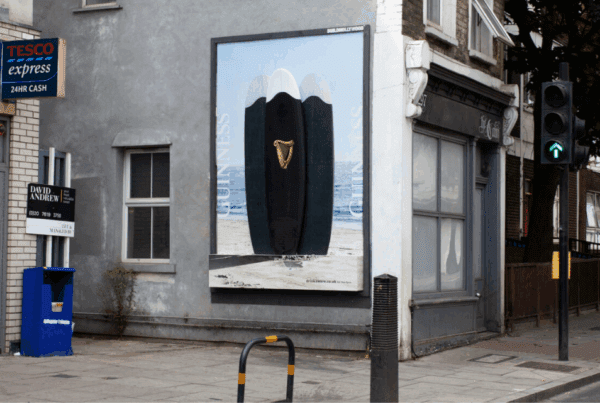
Guinness is over 260 years old, but the Irish stout brand remains a beacon of modern brand-building. The brand is…

One of the primary reasons I gravitated towards Category Entry Points when they were first introduced by Jenni Romaniuk and…
Read more
Clients