Guinness is over 260 years old, but the Irish stout brand remains a beacon of modern brand-building. The brand is now the number one best-selling draught beer in the UK, having seen impressive sales and volume growth in recent years.
One factor behind the success of the brand is consistency. Guinness has a wheelhouse of time-honoured, Distinctive Brand Assets, from its harp logo to the black-and-white pint itself. The brand knows that using these again and again to come to mind in different occasions drives mental availability.
But more than that, Guinness has been able to drive salience for modern consumers by associating itself with particular Category Entry Points. The pint is so popular these days that it’s almost hard to remember, but not so long ago, Guinness was seen almost solely as a winter drink in some markets, to be enjoyed in front of a warm fire in an Irish pub, or on St. Patrick’s Day.
Of course, it continues to assert and reassert those Category Entry Points, emphasising Dublin, St. James’s Gate, and Irish craftsmanship imagery in its advertising. The Guinness Storehouse experience in Dublin is also a physical manifestation of its link to its self-made culture and heritage.
While Guinness has leant into its place as Ireland’s unofficial national drink, and with that, has driven association with related Category Entry Points, it also recognises that it would be a folly to be seen only as a drink to enjoy in an Irish pub.
While these are undoubtedly valuable Category Entry Points, they are also limiting. Association with such a narrow set of occasions is not what carried Guinness to its current best-selling status.
The stout brand has systematically been expanding its Category Entry Points in recent years, something that has allowed it to reach more consumers, more often.
It has done this through campaigns, product innovation, and partnerships while taking care to reinforce its association with its more traditional Category Entry Points.
Not Just for Christmas: Expanding Its Appeal Beyond Winter
Perhaps because of its dark-coloured liquid, there has long been a perception that Guinness is best consumed on a winter’s day. It has been seen as a cosy drink, suited to indoor pub occasions.
While the weather in its native Ireland (and indeed the U.K.) might mean Guinness has plenty of opportunity to shine in cold weather, being associated with winter is limiting, and means the brand is unlikely to come to mind for occasions such as outdoor drinks in beer gardens.
Leveraging the well-established Distinctive Brand Asset of the black-and-white pint, Guinness set out to expand its associations to ensure it is seen as a year-round pint.
This mission took time and was more than any single initiative or campaign. Driving relevance in summertime occasions required sustained effort to build both physical and mental availability, working with pubs to ensure Guinness was available and visible.
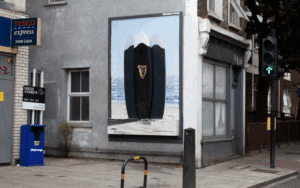
One memorable way Guinness sought to build salience in the summertime occasion was through out-of-home advertising. Working with agency AMV BBDO, it brought to life creative that combined classic images of summer with the distinctive outline of a pint of Guinness.
Source: Talon talonooh.com
Whether it was images of surfboards or deckchairs on a beach, the ads were unmistakably summer, and unmistakably Guinness.
The brand knows its strengths, in this case, very strong Distinctive Brand Assets and has leveraged these to drive relevance in new Category Entry Points, even where it was less familiar territory.
Giving Consumers a Decent Pint at Home: The Introduction of Nitrosurge
Product innovation is another way that brands can drive relevance to particular Category Entry Points. While easier for other “beer” brands, Guinness is unique in how “it travels”, with the can experience not previously matching the in-pub experience, especially from a taste POV. To get around this challenge (itself a point of difference which has overall helped the brand), Guinness drove relevance to the at-home drinking occasion through the introduction of its Nitrosurge product.
Guinness drinkers love pub-poured pints, but having it from a can often doesn’t live up to the experience. During the pandemic, lovers of the stout tried all sorts of solutions to achieve the perfect pour at home when pubs were closed.
Wanting to give consumers the ability to recreate the pour of Guinness on draught, the brand innovated to create the Nitrosurge product, a portable device that uses ultrasonic technology to replicate the smooth, creamy texture and “surge” of a draught pint from a can.
The device is not something every Guinness drinker will buy, but for those passionate about a perfect pour, the innovation makes them more likely to choose Guinness at home. With the device itself a source of revenue, Guinness is also able to use it as a way in to talk to consumers in advertising (while additionally selling the Nitrosurge cans at a higher price point and likely margin. Annoying for consumers, delightful for the bean counters!).

Source: Brand website
Giving the Brand a Sporting Chance: Guinness’s Sponsorship Tactics
Guinness has been sponsoring the Six Nations for almost 20 years, having begun in 2007, though you’d be forgiven for thinking it had been even longer. The partnership has cemented Guinness as the drink of the rugby occasion, particularly during the Six Nations tournament.
It has done this not just through side-of-pitch sponsorship, but through activation in pubs and bars to ensure that during the Six Nations, Guinness enjoys both high mental and physical availability.
Becoming the go-to beer for Six Nations viewers has undoubtedly driven sales for Guinness over the past two decades. However, the stout now has its eye on a broader Category Entry Point: sports watching more generally.
It’s one thing to become the go-to pint for a particular sport, but if Guinness could become the drink of choice for any occasion involving sport and socialising, it would bring a huge advantage.
This is why last year Guinness announced it was becoming the official beer of the Premier League, the most-watched sports league in the world. Football is not only the most popular sport in the UK, but also hugely popular globally.
Guinness leaned into the global popularity of the game, producing several ads for different markets when it announced its sponsorship.
The ad it produced for the UK this year leans not necessarily into football itself, but into the fandom surrounding it. This demonstrates Guinness’s ambition, not just to become the beer of rugby or football, but of any socialising occasion centred around sport.
Moderation Without Compromise: The Role of Guinness 0.0
There’s perhaps no better example of how new products can drive relevance to new Category Entry Points than the introduction of non-alcoholic beers. However, with dozens of new launches from big brands in recent years, it’s also a challenge to stand out.
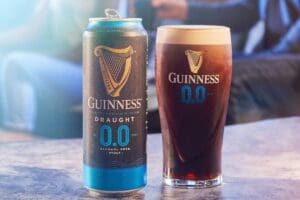
Guinness has certainly achieved this with its 0.0 product. Initially launched in 2020, the non-alcoholic stout has gone on to become the best-selling non-alcoholic beer in the UK.
It has not achieved this by simply launching and leaving the product. While non-alcoholic beer is growing rapidly as a category, it remains relatively nascent in the UK and Ireland, meaning successful brands must guide consumers through the Category Entry Points where the product may come into play.
For Guinness 0.0, one Category Entry Point it has been most successful in associating itself with is moderation without compromise. Guinness is a premium beer brand, known for quality, and a key part of its success in positioning its non-alcoholic version has been showing that it is not a lesser drink just because there’s no alcohol in it.
Source: Brand website
Indeed, “Same great taste, no alcohol” has been one of the key lines it has used in its advertising to emphasise to consumers that they don’t have to settle for something lesser simply because they want to moderate their consumption.
With Guinness 0.0 now enjoying strong physical and mental availability as the best-selling non-alcoholic pint in the UK, it is driving success for the wider brand. Parent company Diageo reports that a significant proportion of those buying Guinness 0.0 are new to the brand altogether, meaning that offering strong quality moderation acts as an entry point into the brand, not just into the 0.0 product.
A Masterclass in Utilising Category Entry Points
At its heart, Guinness’s growth story is one of mastering Category Entry Points. The brand has understood that to drive mental availability, it must be thought of in more buying situations, by more people, more often.
It has successfully expanded its appeal through innovation, as well as advertising and communications, while continuing to build on the Category Entry Points that have kept it top of mind for generations of consumers.
Guinness has shown that even a 260-year-old brand can remain a modern icon by continuing to show up consistently in more of the moments that matter.